Unit 1: Writing a Letter to a Pen Friend — Common Core Writing Lesson
A ready-to-teach presentation that takes students from a model letter to writing their own letter to a pen friend, step by step. Open it and teach.
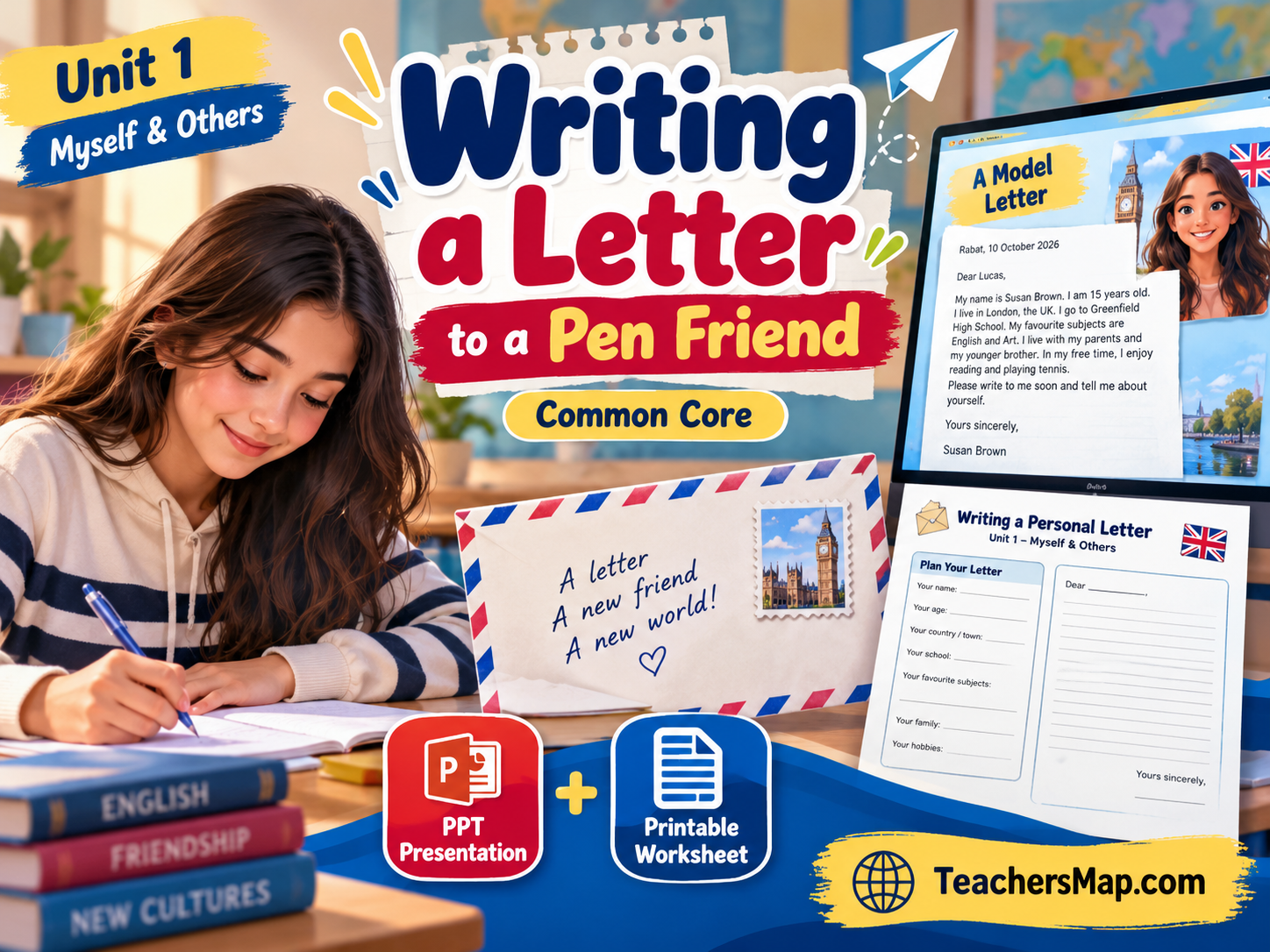
Writing a letter to a pen friend is one of the first writing tasks in Common Core Unit 1, Myself & Others. It sounds easy, but many students don’t know what a letter should look like. They forget the date, mix up the greeting and the closing, or write one long block of text with no structure.
This Common Core Unit 1 writing a letter to a pen friend presentation fixes that. Students first read a model letter, then find the information in it, learn the parts of a letter and what each one does, practise them, plan their own letter and write it. A final checklist helps them correct their work before they hand it in. A ready-made lesson plan comes with it, so you can see how to run each stage. Both are available to download below.
Common Core
Unit 1: Myself & Others
Writing — A Letter to a Pen Friend
PowerPoint (8 slides) + Lesson Plan (Word)
Learning Objectives
By the end of this lesson, students will be able to identify a personal letter, name the six parts of a letter (date, address, greeting, body, closing, signature) and their functions, and plan, write and check a short letter introducing themselves to a pen friend.
What’s Inside This Presentation
1. Read the Letter: What Type of Text Is This?
Students read a letter from Susan, a 16-year-old from England, and decide what type of text it is: an email, a text message, a formal letter or a personal letter.
2. Read Again and Find the Information
A reading-for-detail task. Students find the date, address, name, age, country, school, subjects, family, hobbies and closing in the letter.
3. Parts of a Letter and Their Functions
The letter is labelled part by part, with the function of each one. A box of useful expressions covers greetings, closings and signatures.
4. Practice: Parts of a Letter
Two quick activities: put the parts of a jumbled letter in the correct order, then match each part with its function.
5. Plan and Write Your Own Letter
Students fill in an organiser with their own information (date, address, greeting, body, closing, signature), then write a letter to a new English friend.
6. Check Your Letter
A nine-point checklist for self-checking, plus useful language for introducing yourself, asking for a reply, and closing the letter.
7. A Model Letter from a Moroccan Student
A second model letter from Youssef, a 15-year-old from Tiflet, with every part labelled and a full list of useful expressions. Students can relate to it more easily because he lives in Morocco, like them.
Lesson Plan: Writing a Letter to a Pen Friend
Target Language
Letter parts: date, address, greeting, body, closing, signature. Useful expressions: “My name is…”, “I am … years old”, “I live in…”, “My favourite subjects are…”, “In my free time, I enjoy…”, “Please write back soon.”
Lead-in
5 minAsk students if they have a friend in another town or country and how they could keep in touch. Explain what a pen friend is, then elicit what they could tell one: name, age, town, school, family and hobbies.
Interaction: Teacher ↔ students
Pre-Writing
15 minStudents read the model letter and answer gist and detail questions. They then identify the date, address, greeting, body, closing and signature, discuss what each one is for, and put the parts in order.
Interaction: Individual / pairs
While-Writing
30 minPlanning: students note personal details, school and subjects, family and hobbies, and add a question. Drafting: they write their letter using the plan and the model, with a greeting, an organised body, a closing and a signature.
Interaction: Individual; teacher monitors
Post-Writing
10 minSelf-check: content, letter parts, capital letters, punctuation and spelling. Feedback: students exchange letters or volunteers read selected lines, and you give brief feedback on organisation and clarity.
Interaction: Pairs / class
Assessment: Check the answers to the model-letter questions, how well students identify the parts of a letter, and the final letter. Look for relevant personal information, a suitable structure, a greeting and closing, and understandable language.
Differentiation: Give weaker students sentence starters and let them discuss in pairs. Ask confident students to add more detail and two questions. No projector? Use the model in the textbook, or write the model letter and prompts on the board.
Delivery Tips
💡 Show Youssef’s Letter Before the Writing Task: It comes last in the presentation, but it works well just before students plan their own letter. A model from a Moroccan student gives them a closer example to follow than Susan’s.
💡 No Printing Needed: Students copy the organiser into their notebooks and write the letter there. This works in classes with no printer or photocopies.
💡 Make the Checklist a Peer Task: Before they hand in their letters, students swap notebooks with their neighbour and tick the nine points together. They catch missing dates, greetings and full stops without waiting for you.
Frequently Asked Questions
Which unit is this writing lesson for?
It is a Common Core writing lesson for Unit 1: Myself & Others. Students learn to write a letter to a pen friend, introducing themselves, their school, their family and their hobbies.
Do students need a printed worksheet?
No. The activities are on the slides, so students can copy the plan into their notebooks and write their letter there.
Is there a lesson plan with the presentation?
Yes. A Word lesson plan is included with objectives, target language, a staged procedure (lead-in, pre-writing, while-writing, post-writing), assessment ideas and a no-projector option.
Is this presentation completely free?
Yes, all downloadable documents and presentations on TeachersMap are freely accessible for instructional use.
Presentation Preview
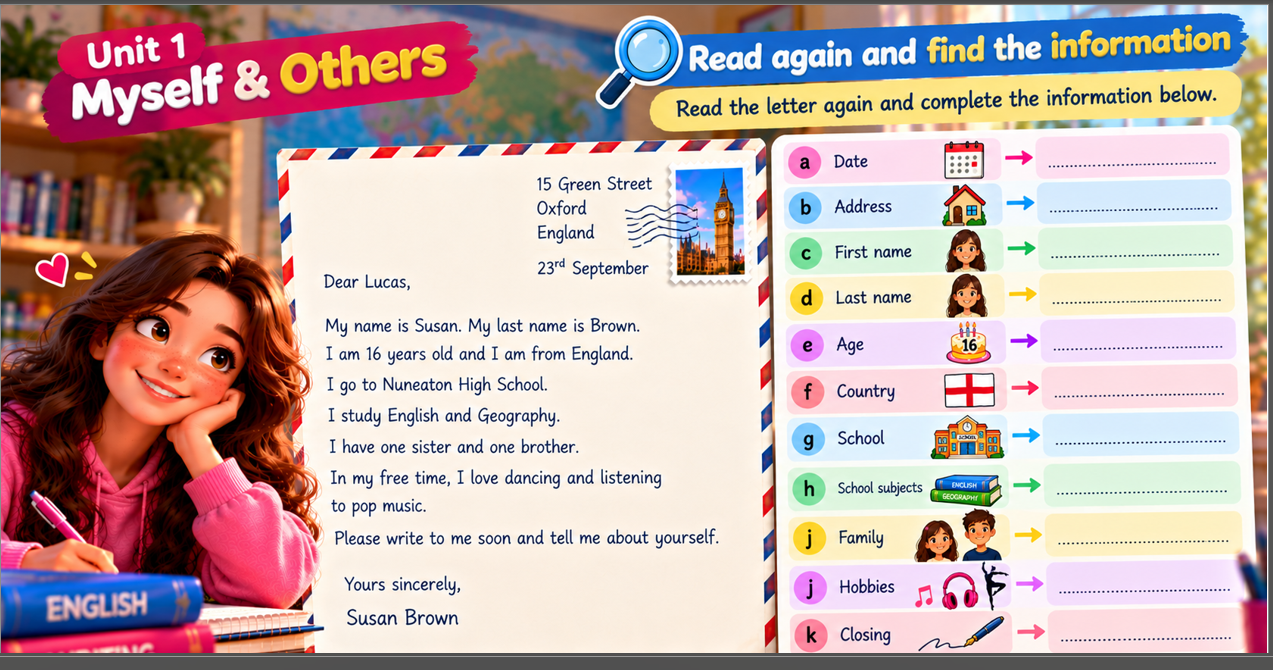
Preview of the slides — download the full presentation and lesson plan below.
Download the presentation and the lesson plan.
Related Materials
View All Common Core →Unit 1: My Favourite Things Listening Presentation
The matching Common Core Unit 1 listening and speaking lesson, with clear audio and modern content.
Unit 1: The Gifts of Youth – Descriptive Paragraph Worksheet
A printable 2nd Year Bac writing worksheet with a model text, mind-map, vocabulary table and gap-fill paragraph.